
 EN



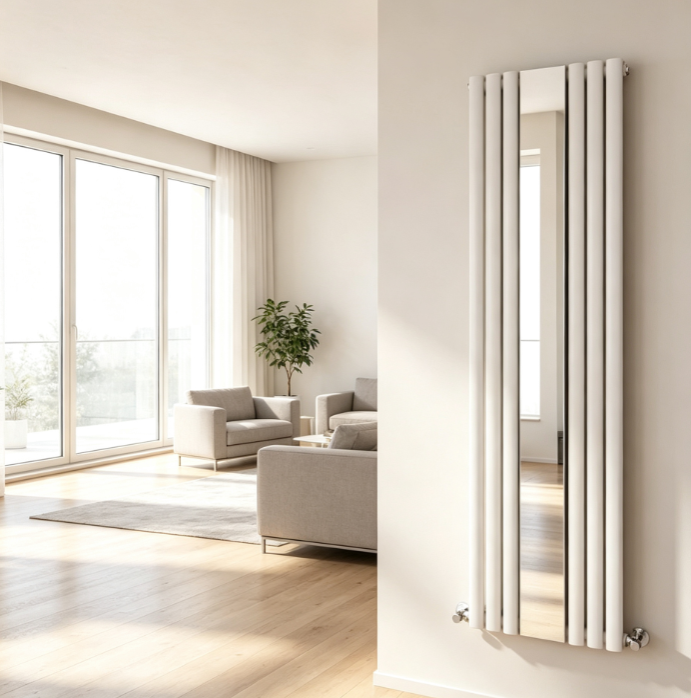
Most people think they know. A radiator heats a room. End of story. But that simple assumption hides a more complicated reality—one that explains why some rooms never feel warm, why walls above radiators turn grey, and why your home heating bill keeps climbing even when the radiators are “working.”
A radiator does three things at once. It transfers heat. It moves air. And it quietly tells you whether your home heating system is balanced or out of tune. Miss those signals, and you’ll spend money heating air that never reaches you.
The Core Job: A Heat Exchanger, Not a Space Heater
A radiator is a heat exchanger. Hot water from the boiler passes through a series of metal fins. Those fins warm the air around them. The warmed air rises. Cooler air slides in underneath. That cycle repeats until the room reaches the temperature set by your thermostatic radiator valve or wall thermostat.
The important part: radiators don’t push heat across a room. They warm the air immediately around them and rely on natural circulation. Anything that blocks that circulation—a sofa, a curtain, a damp towel—reduces the radiator’s effective output. You’re not losing heat. You’re just trapping it in the wrong place.
Reddit user u/ConvectionCurrent on r/DIYUK put it well: “I moved my sofa two feet away from the radiator and the whole room warmed up. Same radiator. Same boiler. Just better airflow.”
The Hidden Job: Air Quality and Wall Marks
Here’s something most homeowners never learn. That gentle convection current carries more than heat. It also lifts dust.
Over months and years, dust particles travel up the wall behind and above the radiator. The warm air deposits them as it cools. The result is a grey, shadowy stain on the wall—often called “ghosting” or “radiator shadow.”
It’s not soot. It’s not mold. It’s dust that has been cooked onto the plaster by years of warm air.
Reddit user u/GhostedWall on r/HomeImprovement shared: “I thought I had black mold above my radiator. Turned out to be dust baked onto the wall from the convection current. A good clean and a coat of paint fixed it. But I also moved the radiator slightly away from the wall.”
This is part of a radiator’s real radiator function: it moves air. That movement has consequences. Keep the area clean. Vacuum behind the radiator occasionally. And if you’re painting, use a washable finish.
The Diagnostic Job: What Your Radiator Tells You
A radiator is a window into your home heating system. If one radiator heats slowly, or stays cool while others are hot, the problem usually isn’t the radiator itself. It’s system balance.
Radiator balancing means adjusting the valves on each radiator so that hot water distributes evenly. Without balancing, the radiators closest to the boiler hog the heat. The ones farthest away never get enough.
Reddit user u/BalancedFlow on r/Plumbing explained: “My upstairs radiators were always cold. I thought the boiler was undersized. A heating engineer spent 30 minutes balancing the system. Now every room heats evenly. Cheapest fix I’ve ever paid for.”
Signs your system needs radiator balancing:
Some radiators get hot quickly, others stay lukewarm
Upstairs rooms never reach temperature
The boiler cycles on and off more than it should
You hear water rushing through pipes
Balancing is not a DIY job for most people. It requires a differential thermometer and patience. But the payoff is better comfort and lower energy efficiency losses.
What Improves Radiator Performance
Thermostatic Radiator Valves (TRVs)
A thermostatic radiator valve replaces a manual on/off valve. It senses room air temperature and adjusts water flow automatically. When the room reaches your set point, the valve closes down. When the room cools, it opens again.
The result is room-by-room control. You’re not heating bedrooms to living-room temperatures. You’re not paying to heat an empty guest room. This is one of the simplest upgrades for home heating energy efficiency.
Reddit user u/ZoneMaster on r/homeautomation shared: “After fitting smart TRVs, my boiler runs about 30% less. The rooms stay exactly where I want them. The house feels more comfortable, and the gas bill dropped.”
The Energy Saving Trust estimates that thermostatic radiator valves can save up to £75 per year for a typical UK home. Payback is around two years.
Avonflow’s thermostatic radiator valve TRCD35 offers ±0.5°C accuracy, Tuya app control, and Keymark/CE certification. It works with both new builds and retrofit projects.
Keep Airflow Clear
Never block the top or bottom of a radiator. Avoid radiator covers unless they are specifically designed for convection. Don’t dry laundry directly on the fins. And leave at least a few inches of space between the radiator and any furniture.
Lower Boiler Flow Temperature
Once TRVs are fitted, you can often reduce boiler flow temperature. Many boilers run at 80°C when 60°C is sufficient. Lower flow temperatures improve condensing energy efficiency. Research by NESTA found that reducing flow temperature from 80°C to 60°C could save a typical UK household around £112 per year on gas.
The catch: lower flow temperatures mean radiators heat more slowly. Thermostatic radiator valves compensate by keeping each room at its target temperature without overheating.
FAQ
Why does my radiator make ticking noises?
Metal expands when heated and contracts when cooled. Ticking is normal. Loud banging or rushing water suggests air in the system or a pressure issue.
Why is the wall above my radiator turning black?
Dust carried by the convection current is being baked onto the wall. Clean the wall, improve ventilation, and vacuum behind the radiator regularly.
How do I know if my radiators need balancing?
If some rooms heat quickly while others stay cold, or if the boiler cycles constantly, radiator balancing is likely needed.
Do I need a thermostatic radiator valve on every radiator?
UK Building Regulations require at least one radiator without a TRV to act as a bypass. Most homes fit TRVs everywhere except the hallway or bathroom.
What size radiator do I need?
Use a BTU calculator based on room volume, insulation, and window size. Oversized radiators waste energy. Undersized radiators never reach temperature.
Can I balance radiators myself?
It’s possible with a differential thermometer and patience, but most homeowners hire a heating engineer. The cost is usually offset by better energy efficiency within a year or two.