
 EN



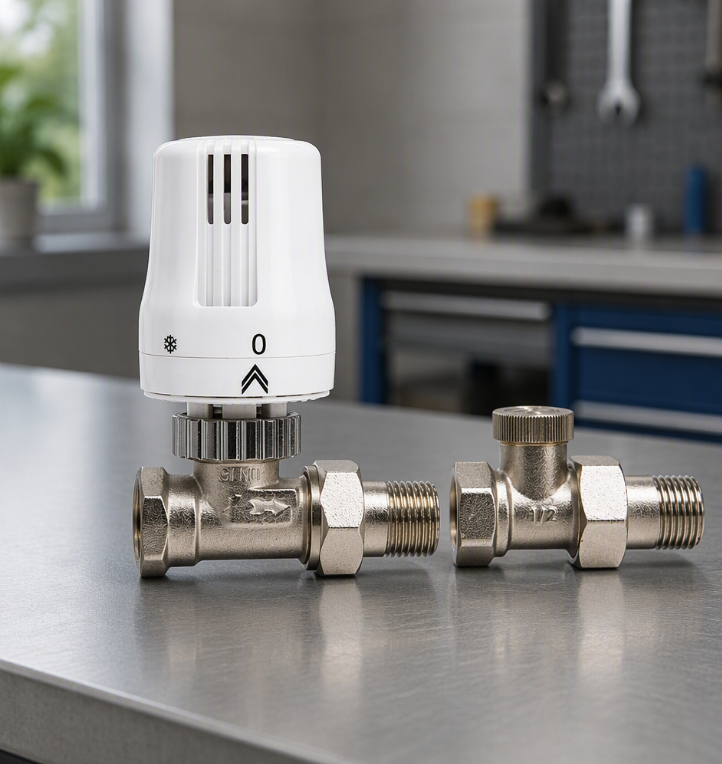
If you’re specifying heating for a new build or advising a customer on a radiator upgrade, you’ll face the same question: manual or thermostatic? It sounds like a minor decision. It isn’t. The valve at the bottom of the radiator determines how much control you have, how much energy you waste, and whether your project meets building regulations.
We break down how MRVs and TRVs work, when each makes sense, and what specifiers need to know before placing a bulk order.
What Does Each Valve Actually Do?
MRV: Manual Radiator Valve
A manual radiator valve (MRV) works like a tap. You twist the head to open or close the flow of hot water. There’s no temperature sensing and no automatic adjustment—just on, off, or somewhere in between.
MRVs are inexpensive, mechanically simple, and reliable. A pair typically costs £10–£30, compared to £15–£40 for a basic TRV. Fewer moving parts mean fewer things to fail. For a rarely used box room or a bathroom towel rail, an MRV is often all you need.
The downside: they rely entirely on human intervention. Leave a radiator fully open in an empty room, and you’re heating nobody’s space. Forget to turn it down before bed, and you wake up too warm. As BestHeating puts it: “They’re a bit like leaving a light on all day—you only save cash if you remember to turn it off.”
TRV: Thermostatic Radiator Valve
A thermostatic radiator valve (TRV) contains a sensor—typically a liquid-filled capsule or wax element—that responds to the air temperature around it. When the room reaches your set point, the valve automatically reduces or stops the hot water flow. When the room cools, it opens again.
The result is room-by-room temperature control without constant fiddling. You’re not heating bedrooms to living-room temperatures, and you’re not paying to heat a guest room nobody’s using.
Reddit user Protoncek on the Home Assistant Community shared: “All my radiators now heat max 50% of the time, so without these valves they heated too much. My room temperature is constantly accurate within half a degree from what I set.”
That’s the practical difference: precise control you don’t have to think about.
Why Does the Choice Matter Financially?
The Energy Saving Trust estimates that fitting TRVs and using them alongside a main thermostat could save up to £75 per year for a typical UK household. Some studies suggest savings of 10–20% on annual heating bills, averaging around 17%.
Recent UK research on air source heat pumps found that TRVs reduced space heating energy use by 6–8% without affecting system efficiency.
Payback is quick. eu.bac research shows average payback on TRVs—including installation—is just two years. A US demonstration project found 3.1 years based on an installed price of $50 per TRV.
For homeowners planning to stay in their property for more than a couple of years, TRVs are one of the lowest-cost, highest-return energy upgrades available.
When Does Building Regulations Require a TRV?
UK Building Regulations Part L requires TRVs (or equivalent zone control) on all radiators except the one in the room with the main thermostat, on new systems and boiler replacements. This is not optional. If you’re specifying heating for a new build or replacing a boiler, you need TRVs to comply.
The reason for the exception matters: one radiator must remain without a TRV to provide a bypass path for the boiler pump. Most installers leave the hallway or bathroom radiator on a manual valve and fit TRVs everywhere else.
For specifiers and contractors, this means MRVs still have a place in every system. The question isn’t which valve to use everywhere—it’s which valve goes where.
Where Does Each Valve Belong?
Rooms That Need a TRV
Living rooms and bedrooms. These are the spaces where comfort matters most and where energy waste happens fastest. A TRV set to position 3 (approximately 20°C) in the living room and position 2 (approximately 16°C) in bedrooms maintains comfort without overheating.
Home offices. If anyone works from home even one day a week, a TRV lets you boost just that room without heating the whole house.
Guest rooms. Set the TRV to the frost protection symbol (approximately 8°C). This prevents damp and frozen pipes without wasting heat on an empty room.
Rooms That Should Keep an MRV
The hallway or wherever the main thermostat is located. This radiator must remain without a TRV to act as the boiler bypass. Fitting a TRV here can cause the boiler to cycle incorrectly or never reach its target temperature.
Bathroom towel rails. Many installers specify MRVs on bathroom towel rails because they’re often used as a secondary heat source and don’t need automatic modulation.
Rarely used rooms. A box room, utility room, or garage radiator that’s only switched on occasionally may not justify the extra cost of a TRV.
Who Benefits Most from TRVs?
Families with young children or elderly relatives should prioritise TRVs in bedrooms and bathrooms, where temperature consistency and safety matter most. TRVs with smooth, enclosed heads are less likely to catch small hands or clothing than exposed manual valves.
Avonflow’s Valve Range: Built for Specifiers
For installers and distributors looking for reliable valves that meet European standards, Avonflow manufactures both TRVs and MRVs with the certifications and specifications that projects demand.
Avonflow TRV TRCD39 — Liquid-filled sensor for accurate temperature response, reversible bi-directional valve body for flexible installation, temperature setting range of 6°C to 28°C with anti-frost protection, rated flow of 173 kg/h, maximum flow temperature of 120°C, fully tested to 10 BAR. Rated TELL A under the Classification Scheme for Energy Efficiency Labelling.
Avonflow MRV range — Brass body construction, compatible with standard 15mm copper pipework, available in straight and angled configurations with chrome or anthracite finishes. Suitable for bathroom radiators, towel rails, and bypass radiator applications.
Both valve types are available with OEM and ODM services for distributors and brand owners looking to private-label. Avonflow supports logo customization, packaging design, and colour options to meet specific market requirements.
FAQ
Can I mix MRVs and TRVs in the same system?
Yes—and you should. UK Building Regulations require at least one radiator without a TRV to provide a bypass path for the boiler pump. Most installers leave the hallway or bathroom radiator on an MRV and fit TRVs everywhere else.
Do TRVs work with underfloor heating?
No. TRVs are designed for radiators. UFH systems use manifold mixing valves and zone controls instead.
How long does it take to retrofit TRVs?
A competent DIYer can replace valve heads in 15–20 minutes per radiator. Full valve body replacement requires draining the system—budget 30–45 minutes per radiator for a professional installer.
Will TRVs save money if I already have a smart thermostat?
Yes, but the savings come from zone control, not boiler modulation. A smart thermostat controls when the boiler fires; TRVs control where the heat goes. The combination is more effective than either alone.
What’s the best TRV setting for a bedroom?
Position 2 (approximately 16°C) is comfortable for most people overnight. Position 3 (20°C) is the upper end of the recommended range for sleeping.
Do I need a bypass valve if I fit TRVs?
If one radiator remains without a TRV, that radiator acts as the bypass. If all radiators have TRVs, you need an automatic bypass valve installed near the boiler.